
Family-owned since 1993, with over 30 years of machine tool experience and field service support from Locher’s Ohio and Texas service footprint.
Precision On-Site expertise
On-Site Spindle Taper Grinding
Efficient Maintenance
On-Site Spindle Taper Grinding
Precision grinding services performed directly at your facility to maintain spindle accuracy and extend machine life.
On-Site Spindle Taper Grinding
Precision grinding services performed directly at your facility to maintain spindle accuracy and extend machine life.
We restore spindle taper contact, reduce runout, and get your machine back into production without automatically pulling the spindle.
Locher, Inc. provides professional on-site spindle taper grinding for machine shops, manufacturers, maintenance teams, and production facilities across the United States. This service is designed to correct worn, bell-mouthed, galled, spun, or crash-damaged spindle tapers directly on the machine, helping restore the critical interface between the machine spindle and the toolholder.
In many recoverable cases, on-site spindle taper grinding can be completed in approximately 5 to 8 hours or within a single service shift. Because the spindle typically does not need to be removed or disassembled, this is a highly efficient, minimally invasive repair option for machines suffering from tool runout, chatter, sticking tools, poor finishes, oversize holes, tool breakage, or unstable cutting performance.
At Locher, we do not treat spindle taper grinding as a simple polishing job. We approach it as a precision restoration service: diagnose, correct, verify, and document.
What Is On-Site Spindle Taper Grinding?
On-site spindle taper grinding is the in-place restoration of the internal spindle taper surface where the toolholder seats inside the machine spindle.
The goal is to restore proper taper contact, improve toolholder seating, reduce runout, and help the machine return to accurate, repeatable cutting performance without immediately requiring spindle removal or full spindle rebuild.
The spindle taper is not just a hole that holds the toolholder. It is the locating surface that determines how the holder centers, repeats, clamps, and transfers cutting force. When that surface is worn, damaged, dirty, bell-mouthed, or loaded with transferred toolholder material, the toolholder can no longer seat correctly.
When the toolholder does not seat correctly, the problem shows up where it hurts most: bad parts, broken tools, poor finish, rejected work, extra setup time, and unnecessary machine downtime.

Our on-site spindle taper grinding minimizes downtime while restoring spindle performance to exact specifications.
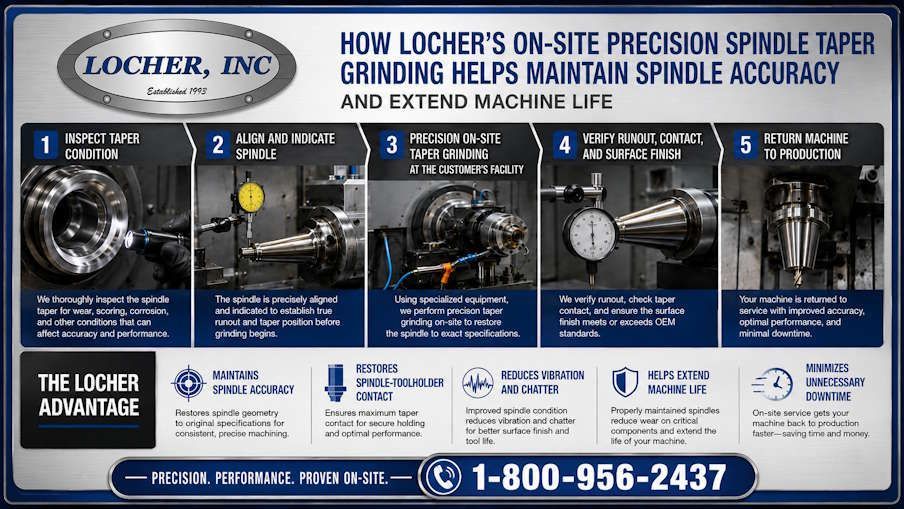
Precision grinding services performed directly at your facility to maintain spindle accuracy and extend machine life.
Efficiency
Precision
Cost-Effectiveness
Why the Spindle Taper Matters
The spindle taper is one of the most important precision interfaces on a machining center, boring mill, mill, or production machine.
It directly affects:
- Tool runout
- Part accuracy
- Surface finish
- Tool life
- Hole size and roundness
- Boring stability
- Cutting performance
- Toolholder repeatability
- Clamp stability
- Machine uptime
A properly restored spindle taper allows the toolholder to center and seat as intended. A damaged taper allows movement, misalignment, vibration, or poor contact between the holder and spindle. Even small taper geometry problems can create measurable error at the cutting end of the tool.
That is why spindle taper condition should be treated as a production-critical issue, not a minor maintenance detail.
Common Problems Caused by a Damaged Spindle Taper
A worn or damaged spindle taper can create a long list of production issues. Many shops first notice the problem when a machine starts producing inconsistent parts, breaking tools, or failing to hold tolerances that it previously held without trouble.
Common symptoms include:
- Excessive spindle or tool runout
- Chatter during cutting
- Poor surface finish
- Oversize holes
- Out-of-round holes
- Tool breakage
- Shortened tool life
- Sticking tools
- Toolholders that do not release cleanly
- Fretting or wear marks on toolholders
- Loss of repeatability after tool changes
- Vibration under load
- Poor boring accuracy
- Inconsistent cutting results from one setup to the next
- Problems after a crash or spun tool event
When these symptoms appear, the spindle taper should be inspected before assuming the entire spindle must be removed, replaced, or rebuilt.
What Causes Spindle Taper Damage?
Spindle taper damage usually develops from one or more of the following conditions:
Spun Tool Events
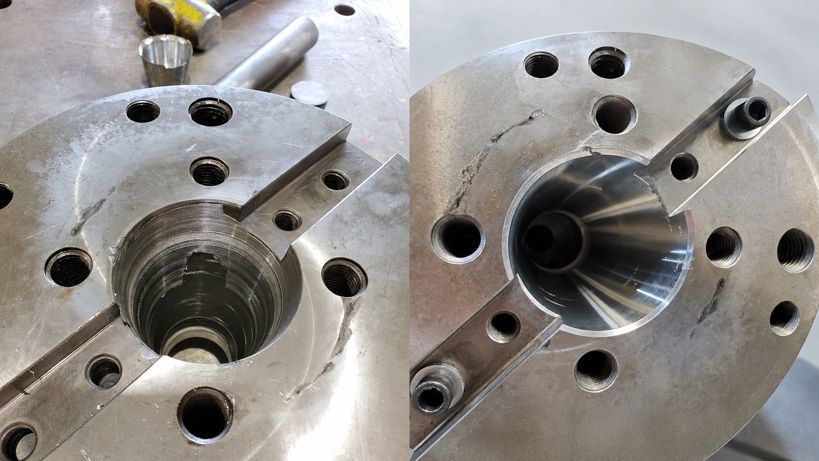
A spun tool event occurs when the cutting pressure exceeds the holding force between the toolholder and the spindle taper. The cutting tool can stall or freeze while the spindle continues turning. This can create extreme friction at the taper interface, sometimes leaving material transfer that looks like the toolholder and spindle taper have been friction welded together.
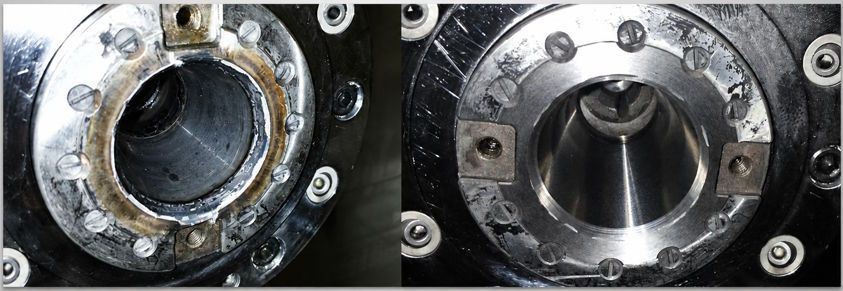
In many cases, the visible damage inside the spindle is transferred toolholder material, galling, or raised material rather than complete spindle failure. When the base spindle geometry is still recoverable, on-site grinding can often remove the damaged material and restore the taper surface.
Bellmouthing
Bellmouthing occurs when the mouth of the spindle taper wears or opens up more than the rest of the taper. This creates poor contact between the toolholder and spindle, often leading to runout, chatter, and unstable tool seating.
Crash Damage
Machine crashes can damage the taper surface, distort the seating area, or leave raised material inside the taper. Even when the machine still runs, the taper may no longer locate the holder correctly.
Material Buildup or Galling
Toolholder material, chips, debris, contamination, or galling can prevent full taper contact. This can keep the holder from seating properly and create runout at the cutting tool.
Low or Incorrect Clamp Force
The drawbar or retention system must provide the correct clamping force for the machine and taper type. Low clamp force can allow movement at the taper interface, which may contribute to fretting, wear, poor finish, and toolholder instability.
Poor Toolholder Condition
Damaged, worn, or dirty toolholders can transfer damage back into the spindle taper. A spindle taper repair should often be paired with toolholder inspection to prevent a damaged holder from re-damaging the spindle.
On-Site Spindle Taper Grinding Process
Advantages of Our On-Site Spindle Taper Grinding Services
Why Choose On-Site Grinding Instead of Pulling the Spindle?
On-site spindle taper grinding is often the preferred first repair option when the taper damage is recoverable and the problem is concentrated at the spindle-toolholder interface.
Instead of removing the spindle, shipping it out, waiting for evaluation, and losing production time, Locher brings the equipment and expertise to the machine. In many cases, the taper can be corrected directly on-site without disassembling the spindle or removing major machine components.
On-site spindle taper grinding can help:
- Reduce machine downtime
- Avoid unnecessary spindle removal
- Restore taper contact
- Improve toolholder seating
- Reduce tool runout
- Improve finish and part accuracy
- Recover machines after spun-tool events
- Extend useful spindle life
- Reduce scrap and rework
- Support planned preventative maintenance
** This service is especially valuable for production environments where every hour of machine downtime matters. **
Our On-Site Spindle Taper Grinding Process
Locher’s process is built around precision correction and measured verification. The goal is not simply to make the taper look better. The goal is to restore the spindle-toolholder interface so the machine can return to reliable production.
1. Machine and Taper Review
We begin by reviewing the machine make, model, spindle type, taper family, tooling system, symptoms, and history of the problem. If there was a crash, spun tool, sticking tool, or recent production issue, that information helps guide the inspection.
2. Baseline Inspection
Before grinding, we inspect the taper condition and look for visible wear, bellmouthing, galling, transferred material, fretting, crash damage, or toolholder seating problems. Where applicable, baseline checks may include:
- Taper contact inspection
- Visual taper condition review
- Test-bar runout review
- Drawbar force review
- Gauge-line relationship review
- Toolholder condition review
3. In-Place Grinding Setup
Once the taper is determined to be a candidate for on-site correction, Locher sets up mobile spindle taper grinding equipment directly on the machine. The spindle does not typically need to be removed for recoverable taper repairs.
4. Precision Taper Regrinding
The internal spindle taper is reground in place to remove damaged material, correct the taper surface, and improve the toolholder seating condition. The amount of material removed depends on the damage, taper condition, and machine requirements.
5. Dual-Contact and Gauge-Line Review
For BIG-PLUS, BBT, and other dual-contact tooling systems, taper grinding must be handled carefully because removing material from the taper changes the toolholder seating depth. These systems depend on the correct relationship between taper contact and spindle-face contact.
When required, spindle-face correction or gauge-line review may be part of the service decision to help maintain the intended taper-and-face relationship.
6. Final Verification
After grinding, the spindle-toolholder interface is checked again. Final verification may include taper contact, test-bar runout, clamp condition, and gauge-line relationship where applicable.
Locher’s objective is to give your maintenance and production teams confidence that the repair has been corrected and verified before the machine goes back into production.
What We Verify After On-Site Spindle Taper Grinding
A professional spindle taper repair should include measurable verification. Locher’s service focuses on correction plus proof. Depending on machine type and application, verification may include:
| Verification Item | Why It Matters |
|---|---|
| Taper contact check | Confirms the toolholder is seating correctly in the spindle taper |
| Blue contact or taper gage review | Helps identify contact pattern and seating condition |
| Certified test-bar runout check | Measures spindle/toolholder alignment and runout behavior |
| Drawbar or clamping force review | Helps confirm the toolholder is being retained with proper force |
| Gauge-line review | Helps confirm seating depth and toolchanger relationship |
| Dual-contact face review | Important for BIG-PLUS, BBT, and other taper-and-face contact systems |
| Final service report | Gives maintenance teams documented results and next-step recommendations |
Locher, Inc. | Toll Free: 1-800-956-2437
Example tolerance benchmarks: OEM maintenance references often cite values such as 800-956-2437 in. TIR at the taper, 800-956-2437 in. TIR at the gauge line, 0.001 in. TIR at 6 inches from the gauge line, and at least 75% blue-contact transfer. These values are useful benchmarks, but final acceptance criteria should always be reviewed against the specific machine builder, spindle design, taper type, and application.

RSL2 lathe center regrind
“Andy came to our plant to regrind the center on our RSL2 lathe. He did a great job.”
- Mark W. Hughes, Siemens Energy
Supported Spindle Taper Types
Locher supports a wide range of spindle taper grinding applications. Common supported taper families include:
- CAT 30
- CAT 40
- CAT 45
- CAT 50
- CAT 60
- BT 30
- BT 40
- BT 45
- BT 50
- BIG-PLUS
- BBT
- Ingersoll Simul-Fit
- Morse tapers
- HSK applications, depending on machine and spindle design
- Certain OD and ID lathe chuck tapers
- Select specialty tapers by review
Because spindle designs and OEM configurations vary, final service eligibility should be confirmed by machine make, model, taper type, and condition.
Gauge-Line and Dual-Contact Considerations
Gauge-line control is one of the reasons spindle taper grinding should be performed by experienced spindle service technicians rather than treated as a generic grinding task.
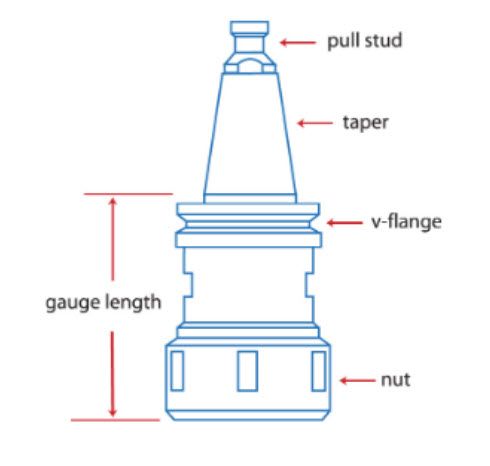
For CAT-style interfaces, a common gauge-line reference is
0.750 in. from the holder flange to the spindle nose. BT interfaces vary by taper size. For example, common BT gauge-line references include:
| Taper Type | Common Gauge-Line Reference |
|---|---|
| BT30 | 0.866 in. |
| BT35 | 0.866 in. |
| BT40 | 1.063 in. |
| BT45 | 1.299 in. |
| BT50 | 1.496 in. |
These values should be treated as reference points, not universal promises. Some machine builders use unique or non-standard gauge-line requirements. For that reason, Locher evaluates the specific machine, tooling system, and application before determining the correct repair path.
This is especially important for BIG-PLUS, BBT, and dual-contact systems, where the holder is designed to contact both the taper and spindle face. If the taper is ground without considering seating depth and face relationship, the toolholder may no longer contact the spindle as intended.
That is why Locher evaluates taper condition, gauge-line relationship, and dual-contact requirements together when the machine design requires it.
Drawbar Force and Tool Retention Matter
Spindle taper grinding can restore the taper surface, but the toolholder still depends on proper clamping force. If drawbar force is low, inconsistent, or outside the machine’s expected range, toolholding problems can continue even after taper correction.
Drawbar force affects:
- Toolholder seating stability
- Cutting rigidity
- Fretting at the taper interface
- Tool life
- Finish quality
- Runout under load
- Tool release and retention performance
Some OEM reference examples show drawbar force ranges such as:
| Example Machine/Taper Category | Example Drawbar Force Range |
|---|---|
| 40 taper machining centers | 1,460 to 2,300 lbf |
| 50 taper machining centers | 2,810 to 4,400 lbf |
| HSK-A63 applications | 2,835 to 4,050 lbf |
Locher, Inc. | Toll Free: 1-800-956-2437
Note: These are example reference ranges only. Correct drawbar force must be confirmed against the specific machine builder, spindle type, retention system, and tooling configuration.
When On-Site Spindle Taper Grinding Is the Right Repair
On-site spindle taper grinding is often appropriate when:
- The taper is worn but still recoverable
- The machine has runout caused by taper seating problems
- A spun tool left transferred material inside the taper
- The taper is bell-mouthed
- The machine has chatter or poor finish related to holder seating
- Toolholders are sticking or releasing poorly
- The spindle taper has crash damage that can be responsibly corrected
- The machine needs preventive taper maintenance
- Production downtime needs to be minimized
When Grinding May Not Be Enough
Not every spindle taper can or should be repaired by grinding alone. That is part of doing the job responsibly.
On-site grinding may not be the correct solution when:
- The taper damage is too severe for safe stock removal
- The spindle has deeper mechanical damage
- Bearing condition is the primary problem
- The taper has already been over-ground
- Gauge-line position cannot be maintained
- A dual-contact system cannot be corrected properly with taper grinding alone
- A replaceable spindle insert, spindle rebuild, or spindle replacement is the better repair path
If the spindle taper is not a good candidate for on-site grinding, Locher can help evaluate the next proper repair option rather than forcing the wrong solution.
On-Site Spindle Taper Grinding as Preventive Maintenance
Many shops wait until the machine is producing scrap before inspecting the taper. That is expensive maintenance by ambush.
On-site spindle taper grinding can also be used as a planned maintenance service for high-use machines. Over time, even well-maintained machines can develop taper wear from production loads, repeated tool changes, chips, coolant contamination, toolholder wear, and clamp-force issues.
Preventive taper inspection and correction can help:
- Maintain toolholder contact
- Reduce runout before it becomes a production problem
- Protect tool life
- Improve finish consistency
- Reduce scrap
- Avoid emergency downtime
- Extend spindle service life
- Support annual machine maintenance programs
For production-critical equipment, maintaining the spindle taper should be viewed the same way as maintaining alignment, lubrication, drawbar force, and machine geometry. It is part of keeping the machine accurate, productive, and predictable.
On-Site Grinding vs. Full Spindle Rebuild
| Question | On-Site Spindle Taper Grinding | Full Spindle Rebuild |
|---|---|---|
| What is the main purpose? | Restores the spindle taper surface where the toolholder seats, helping correct taper contact, runout, toolholder seating, and interface-related cutting problems. | Restores or repairs the full spindle assembly, including internal components such as bearings, shafts, seals, spacers, and other mechanical spindle elements. |
| Is the spindle removed from the machine? | Usually no, when the taper is recoverable. The service is performed in place on the machine. | Yes. The spindle is removed from the machine and typically sent out or taken apart for full repair. |
| Is the machine disassembled? | Typically no major machine disassembly is required. The service is minimally invasive compared with pulling the spindle. | Yes. The machine must be opened enough to remove the spindle assembly, which usually means more labor, downtime, and coordination. |
| Typical downtime | Often completed in one shift or less for recoverable taper conditions. Locher’s common field-service range is typically about 5 to 8 hours, depending on machine condition and verification needs. | Usually longer. Downtime may include spindle removal, shipping or transport, teardown, inspection, parts availability, repair, reassembly, balancing, return shipment, reinstallation, and final machine alignment or testing. |
| Best for | Worn, bell-mouthed, galled, spun, or damaged taper surfaces where the spindle-toolholder interface is the primary issue and the spindle is otherwise mechanically sound. | Bearing failure, major spindle damage, severe internal wear, excessive heat or noise, vibration from internal spindle faults, damaged shafts, failed seals, or conditions that cannot be corrected by taper restoration alone. |
| Common symptoms it can address | Tool runout, chatter, poor surface finish, oversize holes, sticking tools, poor toolholder seating, unstable boring performance, premature tool wear, and damage after a spun-tool or crash event. | Growling or noisy bearings, excessive spindle heat, mechanical vibration, loss of preload, internal spindle damage, spindle seizure, bearing contamination, or failure that extends beyond the taper surface. |
| Main repair area | The internal spindle taper and, when required, the spindle face or gauge-line relationship on dual-contact systems. | The entire spindle cartridge or spindle assembly, including internal rotating components. |
| Main goal | Restore the spindle-toolholder interface so the toolholder seats properly, runs more accurately, and transfers cutting force more predictably. | Restore the complete spindle assembly to proper mechanical operating condition. |
| Cost impact | Often lower than a full spindle removal and rebuild because it avoids major disassembly, shipping, extended machine downtime, and unnecessary replacement when the taper is recoverable. | Typically higher because it involves more labor, more downtime, more parts, more testing, and more handling of the spindle assembly. |
| Production impact | Faster return to service in recoverable cases. This is often the better first repair path when the machine is down because of taper contact, runout, or spun-tool damage. | More extended production interruption. A rebuild may be necessary, but it usually removes the machine from production for a longer period. |
| Can it fix spun-tool damage? | Often, yes. In many spun-tool events, the visible damage is transferred toolholder material, galling, or raised material inside the taper. If the base spindle geometry is recoverable, on-site grinding can often restore the taper surface. | Yes, but it may be more repair than necessary if the damage is limited to the taper interface and the spindle assembly is otherwise healthy. |
| Can it fix bearing problems? | No. On-site spindle taper grinding does not repair failed spindle bearings or internal spindle damage. | Yes. Bearing failure and internal spindle problems are common reasons to choose a full spindle rebuild. |
| Can it help with tool runout? | Yes, when the runout is caused by poor taper contact, taper wear, bellmouthing, galling, toolholder seating problems, or taper geometry issues. | Yes, if the runout is caused by deeper spindle mechanical problems, bearing issues, shaft damage, or full assembly wear. |
| Can it help with chatter and poor finish? | Yes, when chatter and finish problems are caused by poor toolholder seating, taper wear, runout, or unstable spindle-toolholder contact. | Yes, when chatter and finish problems are caused by internal spindle condition, bearing failure, or larger mechanical defects. |
| Verification after service | Taper contact, blue-contact or taper-contact pattern, certified test-bar runout, clamping pressure or drawbar force, gauge-line relationship where applicable, and dual-contact face relationship when required. | Full spindle repair verification may include bearing condition, runout, vibration analysis, balance, preload, temperature behavior, assembly testing, and machine performance checks after reinstallation. |
| Gauge-line considerations | Very important. Grinding removes material from the taper, which can change tool seating depth. This matters especially on CAT, BT, BIG-PLUS, BBT, and dual-contact systems. | Also important after reinstallation, but the rebuild focuses on the entire spindle assembly rather than only the taper interface. |
| Dual-contact considerations | Critical for BIG-PLUS, BBT, and similar systems. These require the correct relationship between taper contact and spindle-face contact. Taper grinding may require spindle-face correction to preserve proper dual contact. | Dual-contact geometry may still need to be confirmed after rebuild, especially if spindle components, face surfaces, or taper geometry were corrected. |
| When this is the better first option | When the spindle is mechanically sound but the taper is worn, spun, bell-mouthed, galled, or no longer seating the toolholder correctly. | When there are signs of internal spindle failure, bearing damage, overheating, severe vibration, or damage beyond the taper surface. |
| When this is not enough | If the taper is too severely damaged, already over-ground, unable to hold gauge-line requirements, or the spindle has internal mechanical problems. | A rebuild may still not be enough if the machine has broader alignment, toolchanger, drawbar, lubrication, crash, or structural issues outside the spindle assembly. |
| Preventive maintenance value | Strong. On-site taper grinding can be used as planned maintenance to keep the taper surface clean, accurate, and consistent before runout, chatter, or scrap becomes a larger problem. | Usually more reactive unless part of a planned spindle overhaul program. Rebuilds are often performed after wear or failure becomes more serious. |
| Customer takeaway | If the machine has taper-related runout, chatter, sticking tools, poor finish, or spun-tool damage, on-site spindle taper grinding is often the fastest and least invasive repair path to evaluate first. | If the spindle has internal mechanical failure, bearing damage, heat, noise, or severe vibration, a full spindle rebuild may be the correct repair path. |
Locher, Inc. | Toll Free: 1-800-956-2437
* NOTE: On-site spindle taper grinding is not a replacement for every spindle rebuild. It is the right first question when the main problem is the taper interface and the spindle is otherwise recoverable.
Why Manufacturers Choose Locher for On-Site Spindle Taper Grinding
Locher, Inc. is not simply a field grinding provider. We support spindle taper correction with deep spindle service experience, precision metrology, machine repair knowledge, and practical manufacturing understanding.
Customers choose Locher because we focus on:
- In-place spindle taper correction
- Nationwide field service availability
- Minimal machine disruption
- Precision taper restoration
- Spun-tool and crash-damage recovery
- BIG-PLUS, BBT, CAT, BT, Morse, and specialty taper experience
- Taper contact and test-bar verification
- Drawbar and clamping-force awareness
- Gauge-line and dual-contact considerations
- Clear recommendations when grinding is not the correct repair
The goal is simple: help your machine get back to making accurate parts as quickly and responsibly as possible.
Request an On-Site Spindle Taper Grinding Quote
If your machine is showing tool runout, chatter, sticking tools, poor finish, tool breakage, oversize holes, or damage after a crash or spun tool event, the first question should not be, “How fast can we replace the spindle?”
The better question is: Can this spindle taper be recovered in place? Locher can help you answer that.
To request a quote, please provide:
- Machine make and model
- Spindle taper type
- Tooling system
- Description of the problem
- Photos of the spindle taper if available
- Photos of any damaged toolholder if available
- Recent crash or spun-tool history
- Current runout or finish issues
- Any known drawbar or tool release problems
If your machine is showing tool runout, chatter, sticking tools, poor finish, tool breakage, oversize holes, or damage after a crash or spun tool event, the first question should not be, “How fast can we replace the spindle?”
The better question is: Can this spindle taper be recovered in place? Locher can help you answer that.
To request a quote, please provide:
- Machine make and model
- Spindle taper type
- Tooling system
- Description of the problem
- Photos of the spindle taper if available
- Photos of any damaged toolholder if available
- Recent crash or spun-tool history
- Current runout or finish issues
- Any known drawbar or tool release problems
SPINDLE TAPER GRINDING FAQs
How long does on-site spindle taper grinding usually take?
In many recoverable cases, on-site spindle taper grinding can be completed in approximately 5 to 8 hours or within one service shift. Actual time depends on machine condition, taper type, damage severity, setup requirements, verification needs, and whether dual-contact or gauge-line correction is required.
Does the spindle need to be removed for on-site taper grinding?
Usually, no. On-site spindle taper grinding is designed to correct the spindle taper in place on the machine when the taper is recoverable. This can help avoid the downtime, cost, and disruption of pulling the spindle for a full rebuild.
What problems can spindle taper grinding fix?
Spindle taper grinding can help correct worn tapers, bellmouthing, galling, transferred material from spun tools, crash-related taper damage, toolholder seating problems, runout, chatter, sticking tools, poor finish, and certain accuracy issues caused by a damaged spindle-toolholder interface.
Can a spun tool damage the spindle taper?
Yes. A spun tool can create extreme friction between the toolholder and spindle taper. This may leave transferred material, galling, or raised damage inside the taper. In many recoverable cases, on-site grinding can remove the damaged material and restore proper taper contact.
What is checked after spindle taper grinding?
After grinding, Locher may verify taper contact, test-bar runout, clamping condition, gauge-line relationship, and dual-contact face relationship where applicable. The goal is to confirm that the spindle-toolholder interface has been corrected before the machine returns to production.
Is spindle taper grinding the same as a spindle rebuild?
No. Spindle taper grinding focuses on restoring the taper interface where the toolholder seats. A spindle rebuild addresses the entire spindle assembly, including bearings and other internal components. If the spindle taper is recoverable and the deeper spindle assembly is sound, on-site grinding may avoid the need for a full rebuild.
Can on-site spindle taper grinding be used as preventive maintenance?
Yes. On-site spindle taper grinding can be used as preventive maintenance for high-use machines. Regular taper inspection and correction can help reduce runout, protect tool life, improve finish consistency, and prevent minor taper wear from becoming a larger production problem.
What brands does Locher service?
Locher services many common brands such as (but not limited to)
Amada, ANCA, BLOHM, Brother, Chiron, Citizen, Daewoo, DN Solutions, Doosan, DMG MORI, Enshu, FANUC, Fidia, Fryer Machine Systems, GF Machining Solutions (AgieCharmilles), GROB, Haas Automation, Hardinge, Hermle, Hurco, Hwacheon, Hyundai WIA, INDEX, Kitamura, Kira, Makino, Matsuura, Mazak (Yamazaki Mazak), Mitsubishi Heavy Industries Machine Tool (Nidec), Nakamura-Tome, Okamoto, Okuma, Sodick, Star CNC, Starrag, Takamaz, Takisawa, Tornos, Toyoda, TRUMPF, Tsugami, Yasd.
Final service eligibility should be confirmed by machine make, model, taper type, and condition.
Why is gauge-line control important?
Gauge-line control affects how deeply the toolholder seats in the spindle and how the toolchanger, gripper, clamp system, and cutting geometry relate to the spindle. On dual-contact systems, gauge-line and face-contact relationships are especially important because the holder is intended to contact both the taper and spindle face.
How do I know if my spindle taper is recoverable?
The best way to know is to have Locher review the machine, taper type, symptoms, photos, and any available runout or toolholder information. If the taper can be responsibly restored in place, on-site grinding may be the best repair. If the damage is too severe, Locher can recommend the next appropriate repair path.
Showcasing precision and reliability in every grind
On-Site Spindle Taper Grinding Projects


Get in Touch
Contact Locher, Inc for Spindle Taper Grinding Services
Reach out today to discuss your machine tool maintenance needs or request a consultation for on-site spindle taper grinding. Our team is ready to provide the expert precision support you need customized to your equipment.
Email us: 4info@locher.com
Call Us Toll Free @ 800-956-2437
Business Hours
- Mon - Fri
- -
- Sat - Sun
- Closed