
Precision Plug and Taper Gauges
Accurate Interface Assessment
How Do Precision Plug and Taper Gauges Help Verify Spindle and Toolholder Fit?
Precision plug and taper gauges help manufacturers evaluate the fit, contact, and condition of spindle tapers, toolholders, and machine tool interfaces. These gauges provide a practical way to check whether the taper connection is supporting accurate, repeatable, and reliable machine performance.
When a spindle taper or toolholder taper is worn, damaged, contaminated, distorted, or no longer making proper contact, the machine may begin showing symptoms such as chatter, poor surface finish, premature tool wear, runout concerns, inconsistent part accuracy, toolholder movement, or repeatability problems.
Locher supports manufacturers with precision plug and taper gauge concerns as part of a broader machine tool performance strategy. When a shop is trying to determine whether a problem is related to the spindle, toolholder, taper contact, drawbar force, alignment, or machine condition, plug and taper gauges can help bring clarity to the troubleshooting process.
TLDR: Precision plug and taper gauges help verify spindle taper condition, toolholder fit, taper contact, and machine accuracy. Locher helps manufacturers evaluate taper-related concerns that may affect cutting stability, tool life, surface finish, repeatability, and spindle performance.
What Are Precision Plug and Taper Gauges?
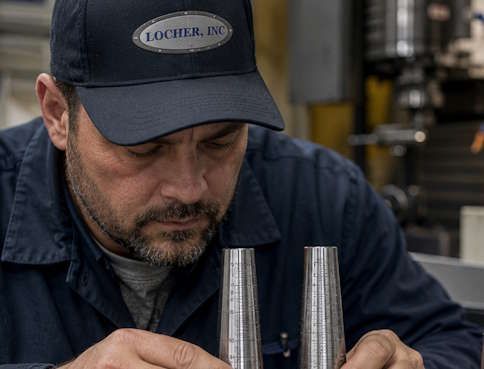
Precision plug and taper gauges are inspection tools used to evaluate tapered machine tool surfaces and related fit conditions. In machine tool service, they are commonly used to help inspect spindle tapers, toolholder tapers, and taper interfaces that affect clamping, seating, accuracy, and repeatability.
A spindle taper plug gauge is typically used to help inspect the internal taper condition of a machine spindle. Toolholder taper gauges, sleeve gauges, or related inspection tools may be used to help evaluate the external taper condition of a toolholder.
These gauges can help support inspection of:
- Spindle taper condition
- Toolholder taper fit
- Taper contact quality
- Seating consistency
- Taper wear
- Taper damage
- High or low contact patterns
- Machine accuracy concerns
- Toolholder repeatability
- Preventative maintenance needs
A plug or taper gauge does not repair the machine by itself. It gives technicians a better way to understand whether the taper interface is helping or hurting machine performance.
That matters because taper problems are excellent at hiding in plain sight. Annoying little gremlins, basically.

Evaluating Wear, Geometry, and Fit with Precision
Why Do Plug and Taper Gauges Matter in Machine Tool Performance?
Plug and taper gauges matter because the taper connection between the spindle and toolholder is one of the most important contact points in the machine tool system. If the taper does not seat correctly, the machine may lose accuracy, cutting stability, and repeatability. Even if the spindle still turns and the toolholder still clamps, poor taper contact can quietly create production problems.
| Gauge Function | Why It Matters |
|---|---|
| Checks spindle taper condition | Helps identify whether the spindle taper may be worn, damaged, or out of condition |
| Supports toolholder fit evaluation | Helps determine whether toolholders are seating properly |
| Helps identify taper contact problems | Poor contact can affect accuracy, clamping, and spindle performance |
| Supports runout troubleshooting | Taper condition can contribute to runout-like symptoms |
| Improves maintenance decisions | Helps determine whether cleaning, inspection, repair, or grinding may be needed |
| Supports repeatability | Proper taper fit helps tool changes return more consistently |
| Protects production quality | Helps reduce poor finish, tool wear, chatter, and scrap |
Locher, Inc - Call Toll Free: 1-800-956-2437
When accuracy matters, taper fit is not a side issue. It is part of the foundation.
Ensuring Accurate Taper Contact for Reliable Tool Performance
What Problems Can Precision Plug and Taper Gauges Help Identify?
Precision plug and taper gauges can help identify machine tool problems that may affect spindle performance, toolholder seating, cutting stability, and production reliability.
| Problem Area | What It May Look Like in Production |
|---|---|
| Spindle taper wear | Toolholders may not seat consistently or securely |
| Poor taper contact | Holder may contact unevenly or fail to seat properly |
| Toolholder taper wear | Holder may no longer maintain proper fit with the spindle |
| Runout concerns | Tool position may not hold consistently during machining |
| Chatter or vibration | Cutting may become unstable, especially under load |
| Poor surface finish | Finished parts may show marks, roughness, or vibration patterns |
| Premature tool wear | Tools may wear faster because of poor seating or instability |
| Toolholder movement | Holder may shift or move under cutting forces |
| Repeatability problems | Tool changes may not return to the same position consistently |
| Misdiagnosed spindle problems | Shops may blame the spindle before confirming taper fit and contact |
Locher, Inc - Call Toll Free: 1-800-956-2437
Precision plug and taper gauges are valuable because they help move the conversation from “something is wrong” to “here is what needs to be inspected next.”

Can Precision Plug Gauges Help Check Spindle Taper Condition?
Yes. Precision plug gauges can help check spindle taper condition by providing a known reference surface that can be used to evaluate fit, contact, and seating behavior inside the spindle taper.
If the spindle taper is worn, damaged, bell-mouthed, contaminated, or not contacting correctly, the gauge may help identify whether the taper condition should be investigated further.
Spindle taper condition matters because poor taper contact can affect:
- Toolholder seating
- Toolholder clamping
- Cutting stability
- Surface finish
- Tool life
- Runout concerns
- Repeatability
- Spindle performance
- Machine accuracy
A spindle taper problem does not always announce itself loudly. Sometimes it shows up as bad finish, weird tool wear, or parts that slowly stop behaving. That is exactly why gauge-based inspection matters.

Can Taper Gauges Help Check Toolholder Fit?
Yes. Taper gauges can help evaluate whether a toolholder taper is worn, damaged, distorted, or no longer fitting as expected.
A toolholder may still look usable and still clamp into the spindle, but that does not always mean it is making proper contact. Poor toolholder taper condition can contribute to instability during cutting and may create symptoms that look like spindle or machine problems.
Toolholder taper concerns may contribute to:
- Poor seating
- Fretting
- Toolholder movement
- Runout concerns
- Chatter
- Vibration
- Poor surface finish
- Premature tool wear
- Repeatability issues
- Spindle taper wear over time
Locher helps manufacturers evaluate toolholder fit in connection with spindle taper condition, drawbar force, retention knobs, Belleville washers, precision test bars, and broader machine tool performance.

Identifying taper interface issues to maintain machine accuracy
Can Poor Taper Contact Cause Accuracy Problems?
Yes. Poor taper contact can cause accuracy problems because the toolholder may not seat consistently or remain stable under cutting load.
The taper interface is supposed to support alignment, rigidity, and repeatable tool positioning. When that connection is compromised, the cutting tool may not behave consistently from one tool change, setup, or production run to the next.
Poor taper contact can contribute to:
- Part tolerance issues
- Chatter or vibration
- Poor finish quality
- Toolholder movement
- Shortened tool life
- Increased spindle stress
- Repeatability problems
- Unnecessary troubleshooting
This is why taper inspection should be part of the machine accuracy conversation, especially when a shop is chasing finish, tolerance, or repeatability issues.
Can Plug and Taper Gauges Help Prevent Misdiagnosed Spindle Problems?
Yes. Plug and taper gauges can help prevent misdiagnosed spindle problems by giving technicians a better way to evaluate taper fit before assuming the spindle itself is failing.
A machine may show chatter, poor finish, runout symptoms, toolholder movement, fretting, or inconsistent part quality. Those symptoms may involve the spindle, but they may also involve the toolholder, taper contact, drawbar force, retention knob, Belleville washer stack, alignment, or maintenance condition.
Without checking the taper interface, shops may waste time and money on the wrong fix.
Plug and taper gauges help support a more disciplined diagnostic process by asking the right question first: Is the taper connection actually doing its job? If the answer is no, that needs to be addressed before blaming everything else.
When Should Precision Plug and Taper Gauges Be Used?
Precision plug and taper gauges should be used when spindle taper condition, toolholder fit, or taper contact may be affecting machine performance. Common times to use plug and taper gauges include:
| Situation | Why It Matters |
|---|---|
| Poor surface finish appears | Taper contact may be contributing to cutting instability |
| Parts drift out of tolerance | Toolholder seating or spindle taper condition may be involved |
| Chatter or vibration develops | Poor taper fit can reduce cutting stability |
| Tool wear increases | Instability or poor seating may shorten tool life |
| Runout concerns appear | Taper condition may be part of the runout investigation |
| Toolholders begin sticking | Taper damage, contamination, or fit issues may be involved |
| Fretting is visible | Movement between holder and spindle may be occurring |
| After a machine crash | Taper damage or seating problems should be checked |
| During preventative maintenance | Helps monitor taper condition before major failures occur |
| Before spindle repair decisions | Helps confirm whether taper condition is part of the problem |
Locher, Inc - Call Toll Free: 1-800-956-2437
These gauges are especially useful when the machine is producing symptoms but the cause is not obvious.
Why Should Plug and Taper Gauges Be Part of Preventative Maintenance?
Plug and taper gauges should be part of preventative maintenance because taper condition affects spindle performance, toolholder seating, cutting stability, tool life, and part quality.
Over time, spindle tapers and toolholder tapers can wear, become contaminated, develop contact issues, or lose the fit quality needed for reliable machining. A machine may continue running while the taper connection slowly gets worse.
Regular taper inspection can help reduce the risk of:
- Poor toolholder seating
- Chatter and vibration
- Poor surface finish
- Premature tool wear
- Part accuracy problems
- Toolholder movement
- Spindle taper fretting
- Stuck toolholders
- Repeatability problems
- Unplanned downtime
- Misdiagnosed machine repairs
For precision manufacturing, taper condition is not something to ignore until the machine starts yelling. By then, the repair bill may already be warming up in the bullpen.
How Can Locher Help With Precision Plug and Taper Gauge Concerns?
Locher helps manufacturers evaluate precision plug and taper gauge concerns as part of the complete machine tool system.
A taper-related issue may involve the spindle taper, toolholder taper, drawbar force, retention knob, Belleville washer stack, machine alignment, crash history, cutting load, or maintenance practices. Locher helps customers look at the larger picture so they can make better repair and maintenance decisions.
Locher can support concerns involving:
- Precision plug gauge inspection
- Taper gauge evaluation
- Spindle taper condition
- Toolholder taper condition
- Taper contact concerns
- Toolholder seating problems
- Runout symptoms
- Poor surface finish
- Chatter or vibration
- Premature tool wear
- Stuck toolholders
- Fretting or poor contact
- Repeatability problems
- Related spindle and machine tool service needs
The value is not just checking the taper. The value is understanding what the taper condition means and what should happen next.
How Do Plug and Taper Gauge Results Affect Machine Tool Decisions?
Plug and taper gauge results can help manufacturers decide whether the next step should involve cleaning, toolholder replacement, taper inspection, spindle taper grinding, drawbar force testing, alignment review, preventative maintenance, or spindle repair.
A gauge result should not be viewed in isolation. It should be considered alongside:
- Machine symptoms
- Surface finish changes
- Part accuracy issues
- Tool wear patterns
- Toolholder condition
- Drawbar force readings
- Retention knob condition
- Belleville washer condition
- Precision test bar readings
- Crash history
- Maintenance history
Locher helps customers interpret those concerns as part of a practical repair and maintenance strategy. That is the difference between reacting to symptoms and actually understanding the machine.
Does Locher Support Precision Plug and Taper Gauge Needs Nationwide?
Yes. Locher supports manufacturers with machine tool service, repair, maintenance, and performance-related needs across the country.
Precision plug and taper gauge concerns are not limited to one region, one machine type, or one industry. Manufacturers nationwide deal with taper wear, toolholder seating problems, spindle performance concerns, poor finish, chatter, tool wear, stuck holders, runout symptoms, and repeatability problems.
Locher’s precision plug and taper gauge support fits into a broader national machine tool service strategy focused on helping manufacturers improve uptime, protect critical equipment, and keep production moving.
Whether a customer is operating one critical CNC machine or managing multiple production assets, Locher helps identify practical machine tool solutions that support long-term reliability.
Request a Custom Taper Gauge Quote Below
Locher, Inc QUOTE FORM
Contact Us
Thank you for reaching out to contact us. We understand the urgency of our customer's service related inquiries and will review your email ASAP. Please allow us up to 24 hours to follow-up. We will get back to you as soon as possible.
If this is extremely urgent or an emergency request, please give us a call @ 800-956-2437. We will get back to you as soon as possible.
Ouchhh.... Technology is great when it works, right? Sorry about that... it seems our system's hit a snag and we'll work to resolve the error! In the meantime, please give us a call @ 800-956-2437 so we can help you!
Please feel free to check back later....
Expertise Backed by Decades of Experience
Frequently Asked Questions About Precision Plug and Taper Gauges
What are precision plug and taper gauges?
Precision plug and taper gauges are inspection tools used to help evaluate tapered machine tool surfaces, including spindle tapers and toolholder tapers.
They help technicians check fit, contact, wear, seating condition, and taper-related machine performance concerns.
What is a spindle taper plug gauge used for?
A spindle taper plug gauge is used to help inspect the internal taper condition of a machine tool spindle.
It can help identify whether the spindle taper may be worn, damaged, contaminated, or not contacting properly with the toolholder.
What is a toolholder taper gauge used for?
A toolholder taper gauge is used to help inspect the external taper condition of a toolholder.
It can help determine whether the holder may be worn, distorted, damaged, or no longer fitting properly in the spindle taper.
Can taper problems cause poor surface finish?
Yes. Taper problems can contribute to poor surface finish when the toolholder does not seat correctly or remains unstable during cutting.
Poor taper contact can lead to chatter, vibration, tool movement, and inconsistent cutting performance.
Can plug and taper gauges help check runout concerns?
Yes. Plug and taper gauges can help support runout troubleshooting by evaluating whether taper fit or contact problems may be contributing to the issue.
Runout concerns may also require related inspection with precision test bars, toolholder checks, drawbar force testing, and machine alignment review.
Can a bad taper look like a spindle problem?
Yes. A bad or poorly contacting taper can create symptoms that look like spindle problems, including chatter, poor finish, fretting, runout concerns, toolholder movement, and inconsistent part quality.
That is why taper condition should be reviewed before assuming the spindle is the only problem.
When should spindle tapers be checked?
Spindle tapers should be checked when a machine shows poor surface finish, chatter, toolholder sticking, runout symptoms, toolholder movement, fretting, poor part accuracy, or repeatability problems.
They should also be checked after crashes, during preventative maintenance, and before major spindle repair decisions.
Should toolholder tapers be inspected too?
Yes. Toolholder tapers should be inspected because a worn or damaged holder can create problems even if the spindle taper is in good condition.
A bad toolholder can affect seating, clamping, accuracy, surface finish, tool life, and repeatability.
Are plug and taper gauges part of preventative maintenance?
Yes. Plug and taper gauges should be part of preventative maintenance because they help monitor spindle taper condition, toolholder fit, and taper contact before problems turn into downtime or expensive repairs.
Regular taper checks can help reduce scrap, tool wear, chatter, and misdiagnosed machine problems.
Who should I call for precision plug and taper gauge concerns?
If your shop is dealing with spindle taper concerns, toolholder fit problems, stuck holders, chatter, poor finish, runout symptoms, repeatability problems, or suspected machine accuracy issues, contact Locher.
Call Locher at 1-800-956-2437 to discuss precision plug and taper gauge support, spindle taper condition, and toolholder fit concerns.