Drawbar Retention Force Gauges
Precision Measurement for Reliable Toolholding

How Do Drawbar Retention Force Gauges Help Verify Toolholder Clamping?
Drawbar retention force gauges help manufacturers verify whether a CNC spindle drawbar is applying enough clamping force to hold the toolholder securely in the spindle. This measurement is critical because weak or inconsistent drawbar force can affect toolholder seating, spindle taper contact, cutting stability, tool life, surface finish, part accuracy, and machine reliability.
When drawbar force is too low, the machine may begin showing symptoms such as toolholder movement, tool pullout, chatter, vibration, poor surface finish, premature tool wear, fretting, inconsistent tolerances, or suspected spindle problems.
Locher supports manufacturers with drawbar retention force gauge concerns as part of a broader machine tool performance strategy. When a shop is trying to determine whether a problem is related to the drawbar, Belleville washers, retention knobs, toolholders, spindle taper, or machine condition, drawbar force measurement can help bring clarity to the troubleshooting process.
TLDR: Drawbar retention force gauges help verify whether the spindle drawbar is clamping the toolholder with enough force. Locher helps manufacturers evaluate drawbar force, toolholder clamping, spindle performance, tool pullout, chatter, and machine accuracy concerns.

What Are Drawbar Retention Force Gauges?
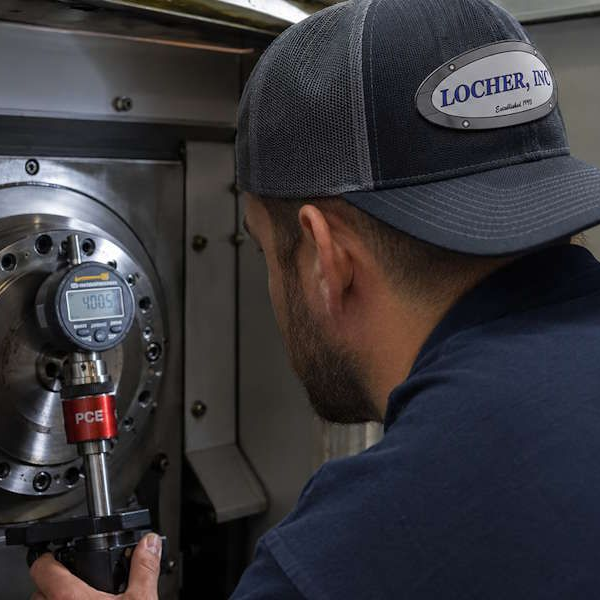
Drawbar retention force gauges are inspection tools used to measure the clamping force produced by a machine tool spindle drawbar. The gauge is typically placed into the spindle interface so the drawbar can clamp onto it, allowing the technician to measure whether the spindle is producing the correct retention force.
These gauges help evaluate whether the machine’s tool clamping system is performing properly.
Drawbar retention force gauges can help support inspection of:
- Spindle drawbar force
- Toolholder clamping strength
- Retention force consistency
- Belleville washer condition
- Retention knob engagement
- Toolholder seating concerns
- Spindle taper contact issues
- Tool pullout risk
- Machine accuracy concerns
- Preventative maintenance needs
A drawbar force gauge does not repair the machine by itself. It gives the technician a measurable way to understand whether the machine is clamping the toolholder with enough force. And that matters because “it feels tight enough” is not exactly a world-class maintenance strategy.

Critical Measurement for Spindle and Tool Reliability
Why Does Drawbar Retention Force Matter?
Drawbar retention force matters because the drawbar is responsible for pulling the toolholder into the spindle and holding it securely during machining. If that clamping force is too low, inconsistent, or unstable, the toolholder may not remain properly seated under cutting load.
That can affect the entire machining process.
| Drawbar Force Function | Why It Matters |
|---|---|
| Clamps the toolholder | Helps pull and hold the holder securely in the spindle |
| Supports taper contact | Helps maintain proper contact between the toolholder and spindle taper |
| Reduces toolholder movement | Helps prevent movement during cutting or heavy load conditions |
| Supports cutting stability | Helps reduce chatter, vibration, and poor surface finish |
| Protects part accuracy | Stable clamping supports more consistent machining results |
| Supports tool life | Poor clamping can increase tool wear and tool breakage risk |
| Improves repeatability | Consistent clamping supports more reliable tool changes |
| Protects spindle performance | Weak clamping can contribute to fretting, taper wear, and spindle concerns |
Locher, Inc - Call Toll Free: 1-800-956-2437
Drawbar force is not just a maintenance number. It is one of the core conditions that helps determine whether the toolholder is secure enough for accurate, reliable production.
Can Drawbar Retention Force Gauges Help Identify Low Clamping Force?
Yes. Drawbar retention force gauges help identify whether the spindle drawbar is producing enough clamping force to hold the toolholder securely.
The gauge gives the technician a measurable reading instead of relying only on symptoms. Once the drawbar force is measured, the result can be compared against the machine builder’s recommended range or service specifications.
Low clamping force can contribute to:
- Toolholder movement
- Poor taper contact
- Tool pullout
- Chatter
- Vibration
- Poor surface finish
- Premature tool wear
- Repeatability problems
- Spindle taper fretting
- Machine accuracy concerns
For manufacturers running precision CNC equipment, drawbar force should never be treated as a mystery. It should be measured, tracked, and reviewed as part of machine tool maintenance.
What Problems Can Low Drawbar Force Cause?
Low drawbar force can create machine tool problems that may be blamed on the spindle, toolholder, cutting tool, retention knob, program, fixture, or operator before the drawbar is checked. Common problems may include:
| Problem Area | What It May Look Like in Production |
|---|---|
| Toolholder movement | The holder may shift during cutting or heavy load conditions |
| Tool pullout | The toolholder may not remain securely retained |
| Chatter or vibration | The cutting process becomes unstable |
| Poor surface finish | Parts may show roughness, vibration marks, or inconsistent finish quality |
| Premature tool wear | Cutting tools may wear faster due to instability |
| Poor part accuracy | Parts may drift out of tolerance |
| Runout-like symptoms | Tool position may not stay consistent under load |
| Fretting or taper marks | Movement between holder and spindle may create contact damage |
| Repeatability problems | Tool changes may not return consistently |
| Misdiagnosed spindle problems | Weak clamping can look like a deeper spindle issue |
Locher, Inc - Call Toll Free: 1-800-956-2437
This is why drawbar force should be checked before making expensive assumptions. Weak clamping can create symptoms that look much bigger than the actual starting point.
Can Low Drawbar Force Look Like a Spindle Problem?
Yes. Low drawbar force can create symptoms that look like spindle problems.
A shop may notice chatter, poor finish, toolholder movement, fretting, runout-like symptoms, inconsistent tolerances, or tool pullout and assume the spindle itself is failing. Sometimes the spindle may be involved. Other times, the drawbar system may not be applying enough force to hold the toolholder securely.
That is why drawbar force, retention knobs, Belleville washers, toolholders, spindle taper condition, and machine alignment should be reviewed together.
Locher helps manufacturers look at the complete machine tool system so the real source of the problem can be identified more clearly. The goal is not to guess. The goal is to measure, diagnose, and fix the right problem.
Complementary Services for Toolholding Precision
How Do Drawbar Force Gauges Support Toolholder Clamping?
Drawbar force gauges support toolholder clamping by confirming whether the spindle drawbar is pulling with enough force through the retention knob or pull stud to hold the toolholder securely in the spindle. If the measured force is too low, the toolholder may not seat firmly enough against the spindle taper. That can allow movement during cutting, especially under load.
Toolholder clamping affects:
- Part accuracy
- Cutting stability
- Tool life
- Surface finish
- Toolholder seating
- Spindle taper contact
- Tool change repeatability
- Machine reliability
- Operator safety
A properly functioning clamping system depends on multiple components working together. The drawbar, Belleville washers, retention knob, toolholder, spindle taper, and machine condition all matter.
How Are Belleville Washers Connected to Drawbar Force?
Belleville washers are commonly used in spindle drawbar systems to help generate the spring force needed for toolholder clamping. When the Belleville washer stack becomes worn, cracked, broken, fatigued, or incorrectly stacked, the drawbar may lose clamping force.
That loss of force can create serious machine performance concerns.
Belleville washer problems may contribute to:
- Low drawbar force
- Weak toolholder clamping
- Toolholder movement
- Tool pullout
- Chatter or vibration
- Poor surface finish
- Premature tool wear
- Fretting or taper contact damage
- Repeatability problems
- Suspected spindle issues
A drawbar retention force gauge can help identify whether force loss is present. From there, the next step may involve reviewing the drawbar assembly, Belleville washer stack, retention knob, toolholder, or spindle condition.
How Are Retention Knobs Connected to Drawbar Force?
Retention knobs, also called pull studs, are the connection point the drawbar grips to pull the toolholder into the spindle. Even if the drawbar is capable of producing force, the retention knob must be correct, secure, and in good condition for clamping to work properly.
Retention knob concerns may affect drawbar force performance when the knob is:
- Worn
- Damaged
- Loose
- Incorrect for the machine
- Incorrect for the toolholder
- Improperly installed
- Not matched to the drawbar system
- Showing damaged threads or pull surfaces
When a drawbar force issue appears, the retention knob should be part of the inspection process. A bad knob can make a good drawbar look bad, and a weak drawbar can make a good knob look suspicious. Machines love drama.
When Should Drawbar Retention Force Be Checked?
Drawbar retention force should be checked when a machine begins showing signs of clamping inconsistency, toolholder movement, spindle performance concerns, or cutting instability. Common reasons to measure drawbar force include:
| Concern | Why It Matters |
|---|---|
| Toolholder movement | May indicate weak or inconsistent clamping |
| Tool pullout | A serious sign of tool retention failure |
| Chatter or vibration | May be connected to poor clamping stability |
| Poor surface finish | Instability can show up in finished part quality |
| Premature tool wear | Poor clamping can shorten cutting tool life |
| Fretting or taper marks | May indicate movement between holder and spindle |
| Repeatability problems | Tool changes may not return consistently |
| Stuck toolholders | May point to taper, drawbar, retention, or clamping issues |
| After a machine crash | Drawbar and clamping components should be reviewed after abnormal events |
| During preventative maintenance | Helps detect force loss before it becomes a production problem |
Locher, Inc - Call Toll Free: 1-800-956-2437
Drawbar force should also be checked when machines are running critical parts, high-value work, heavy cuts, tight tolerances, or production schedules where downtime is especially costly.
Why Should Drawbar Force Gauges Be Part of Preventative Maintenance?
Drawbar force gauges should be part of preventative maintenance because they help manufacturers monitor whether the machine’s tool clamping system is still performing correctly. Over time, drawbar force can decline. Belleville washers can fatigue. Retention knobs can wear. Drawbar components can become damaged. Toolholders can stop seating properly. A machine may continue running while the clamping system quietly becomes less reliable.
Regular drawbar force checks can help reduce the risk of:
- Low clamping force
- Toolholder movement
- Tool pullout
- Poor part quality
- Chatter and vibration
- Poor surface finish
- Premature tool wear
- Spindle taper fretting
- Misdiagnosed spindle problems
- Unplanned downtime
For precision manufacturing, drawbar force is not something to check only after the machine starts wrecking parts. By then, the machine has already sent you the bill.
Send Machine Details for a Custom Drawbar Gauge Quote
How Can Locher Help With Drawbar Retention Force Gauge Concerns?
Locher helps manufacturers evaluate drawbar retention force gauge concerns as part of the complete machine tool system.
A drawbar force problem may involve the drawbar assembly, Belleville washer stack, retention knob, toolholder, spindle taper, actuator, machine alignment, crash history, or maintenance practices. Locher helps customers look at the larger picture so they can make better repair, maintenance, and replacement decisions.
Locher can support concerns involving:
- Drawbar retention force measurement
- Low drawbar force concerns
- Toolholder clamping reliability
- Tool pullout
- Retention knob engagement
- Belleville washer condition
- Spindle taper contact
- Fretting or poor seating
- Cutting instability
- Chatter or vibration
- Poor surface finish
- Repeatability problems
- Related spindle and machine tool service needs
The value is not just getting a drawbar force number. The value is understanding what that number means and what should happen next.
How Do Drawbar Force Readings Affect Machine Tool Decisions?
Drawbar force readings help manufacturers decide whether the next step should involve drawbar service, Belleville washer replacement, retention knob inspection, toolholder review, taper inspection, spindle taper grinding, machine alignment, preventative maintenance, or spindle repair.
A drawbar force reading should not be viewed in isolation. It should be considered alongside:
- Machine symptoms
- Surface finish changes
- Part accuracy issues
- Tool wear patterns
- Toolholder condition
- Retention knob condition
- Belleville washer condition
- Spindle taper condition
- Precision test bar readings
- Crash history
- Maintenance history
Locher helps customers interpret those concerns as part of a practical repair and maintenance strategy. That is how manufacturers avoid guessing and start making better machine tool decisions.
How Can Drawbar Force Measurement Help Avoid Unnecessary Repairs?
Drawbar force measurement can help manufacturers avoid unnecessary repairs by narrowing down whether a performance issue is related to clamping force, toolholders, retention knobs, Belleville washers, spindle taper condition, or another machine condition.
Without checking drawbar force, a shop may replace cutting tools, swap holders, adjust programs, blame fixtures, or schedule spindle service before confirming whether the toolholder is actually being clamped correctly.
That gets expensive quickly.
Locher helps manufacturers take a smarter approach. If drawbar force is low, that should be identified early. If drawbar force is acceptable and the issue points elsewhere, the shop can move to the next diagnostic step with better confidence.
The goal is simple: measure first, diagnose smarter, and fix the right problem.
Does Locher Support Drawbar Retention Force Gauge Needs Nationwide?
Yes. Locher supports manufacturers with machine tool service, repair, maintenance, and performance-related needs across the country.
Drawbar force and toolholder clamping concerns are not limited to one region, one machine type, or one industry. Manufacturers nationwide deal with toolholder movement, tool pullout, poor finish, chatter, tool wear, spindle taper concerns, repeatability problems, and machine accuracy issues.
Locher’s drawbar retention force gauge support fits into a broader national machine tool service strategy focused on helping manufacturers improve uptime, protect critical equipment, and keep production moving.
Whether a customer is operating one critical CNC machine or managing multiple production assets, Locher helps identify practical machine tool solutions that support long-term reliability.
What Should You Do If You Suspect a Drawbar Force Problem?
If your machine is showing clamping, accuracy, finish, or repeatability problems, drawbar force should be part of the inspection process.
Start by asking:
- Is drawbar retention force low or inconsistent?
- Is the toolholder moving during cutting?
- Has tool pullout occurred?
- Is there chatter or vibration under load?
- Has surface finish quality changed?
- Are tools wearing out faster than expected?
- Are parts drifting out of tolerance?
- Is there visible fretting or taper contact damage?
- Are toolholders sticking in the spindle?
- Did the problem begin after a crash, overload, or tooling change?
If the answer is yes, the drawbar force measurement may help identify whether the clamping system is contributing to the problem.
Locher can help evaluate the concern and determine whether the issue may be related to drawbar force, Belleville washers, retention knobs, toolholders, spindle taper condition, alignment, or another machine condition affecting performance.
Do You Need Help With Drawbar Retention Force or Toolholder Clamping Issues?
If your shop is dealing with low drawbar force, toolholder movement, tool pullout, chatter, premature tool wear, poor surface finish, repeatability problems, or suspected spindle performance issues, drawbar retention force should be checked as part of the troubleshooting process.
Locher helps manufacturers evaluate drawbar retention force gauge concerns as part of a broader machine tool performance strategy. The goal is to help identify the real issue, reduce unnecessary downtime, and support more reliable production.
For manufacturers focused on accuracy, uptime, and long-term machine reliability, drawbar force should never be left to guesswork. Call Locher at 1-800-956-2437 to discuss drawbar retention force gauges, toolholder clamping, and spindle performance concerns.
Why Choose Locher for Drawbar Retention Force Gauge Support?
Manufacturers choose Locher because machine tool problems are rarely solved by guessing. A drawbar force issue may look like a spindle issue. A spindle issue may look like a toolholder issue. A toolholder issue may look like a retention knob or taper issue. Locher helps customers work through those possibilities with practical machine tool experience and a focus on solving the right problem.
Locher supports manufacturers that need more than a gauge reading. They need a machine tool service partner that understands how drawbar force gauges, Belleville washers, retention knobs, toolholders, spindles, tapers, machine alignment, and preventative maintenance all work together.
When clamping force, accuracy, repeatability, and uptime matter, Locher helps manufacturers move from symptoms to solutions. Talk with Locher today about drawbar retention force gauges, toolholder clamping, spindle performance, and machine accuracy support.
Locher, Inc QUOTE FORM
Contact Us
Thank you for reaching out to contact us. We understand the urgency of our customer's service related inquiries and will review your email ASAP. Please allow us up to 24 hours to follow-up. We will get back to you as soon as possible.
If this is extremely urgent or an emergency request, please give us a call @ 800-956-2437. We will get back to you as soon as possible.
Ouchhh.... Technology is great when it works, right? Sorry about that... it seems our system's hit a snag and we'll work to resolve the error! In the meantime, please give us a call @ 800-956-2437 so we can help you!
Please feel free to check back later....
Expertise Backed by Decades of Experience
Frequently Asked Questions About Drawbar Retention Force Gauges
What is a drawbar retention force gauge?
A drawbar retention force gauge is an inspection tool used to measure the clamping force produced by a machine tool spindle drawbar.
It helps technicians determine whether the drawbar is applying enough force to hold the toolholder securely in the spindle.
What does a drawbar force gauge measure?
A drawbar force gauge measures the force created by the spindle drawbar when it clamps onto the gauge.
This helps confirm whether the machine’s toolholder clamping system is producing the correct retention force for safe, stable, and accurate machining.
Why is drawbar retention force important?
Drawbar retention force is important because it helps keep the toolholder securely seated in the spindle during machining.
If the force is too low, the toolholder may move, chatter, pull out, or fail to maintain proper contact with the spindle taper.
Can low drawbar force cause toolholder pullout?
Yes. Low drawbar force can contribute to toolholder pullout because the toolholder may not be clamped securely enough to resist cutting forces.
Toolholder pullout is a serious machine tool concern and should be evaluated quickly to reduce the risk of part damage, tool damage, spindle damage, or machine downtime.
Can low drawbar force cause poor surface finish?
Yes. Low drawbar force can contribute to poor surface finish when weak clamping allows toolholder movement, vibration, chatter, or unstable cutting conditions.
If finish quality changes unexpectedly, drawbar force should be part of the troubleshooting process.
Can drawbar force problems look like spindle problems?
Yes. Drawbar force problems can look like spindle problems because poor clamping can create chatter, vibration, fretting, poor finish, toolholder movement, runout-like symptoms, and inconsistent part quality.
That is why drawbar force, retention knobs, Belleville washers, toolholders, and spindle taper condition should be reviewed before assuming the spindle is the only problem.
How often should drawbar force be checked?
Drawbar force should be checked regularly as part of preventative maintenance and anytime a machine shows signs of clamping problems, toolholder movement, tool pullout, chatter, poor finish, repeatability issues, or suspected spindle trouble.
High-production shops and precision manufacturers should check drawbar force more often because weak clamping can quickly affect quality and uptime.
What causes low drawbar force?
Low drawbar force may be caused by worn, cracked, broken, or fatigued Belleville washers; drawbar wear; retention knob problems; actuator issues; contamination; damaged clamping components; or other spindle drawbar system concerns.
The cause should be diagnosed before assuming the spindle itself is the only problem.
Are drawbar force gauges part of preventative maintenance?
Yes. Drawbar force gauges should be part of preventative maintenance because they help verify that the machine’s toolholder clamping system is still performing correctly.
Regular checks can help catch clamping problems before they cause toolholder movement, tool pullout, poor finish, tool wear, scrap, or downtime.
Who should I call for drawbar retention force gauge concerns?
If your shop is dealing with low drawbar force, toolholder movement, tool pullout, chatter, vibration, poor finish, repeatability problems, or suspected spindle performance issues, contact Locher.
Call Locher at 1-800-956-2437 to discuss drawbar retention force gauges, toolholder clamping, and spindle performance concerns.